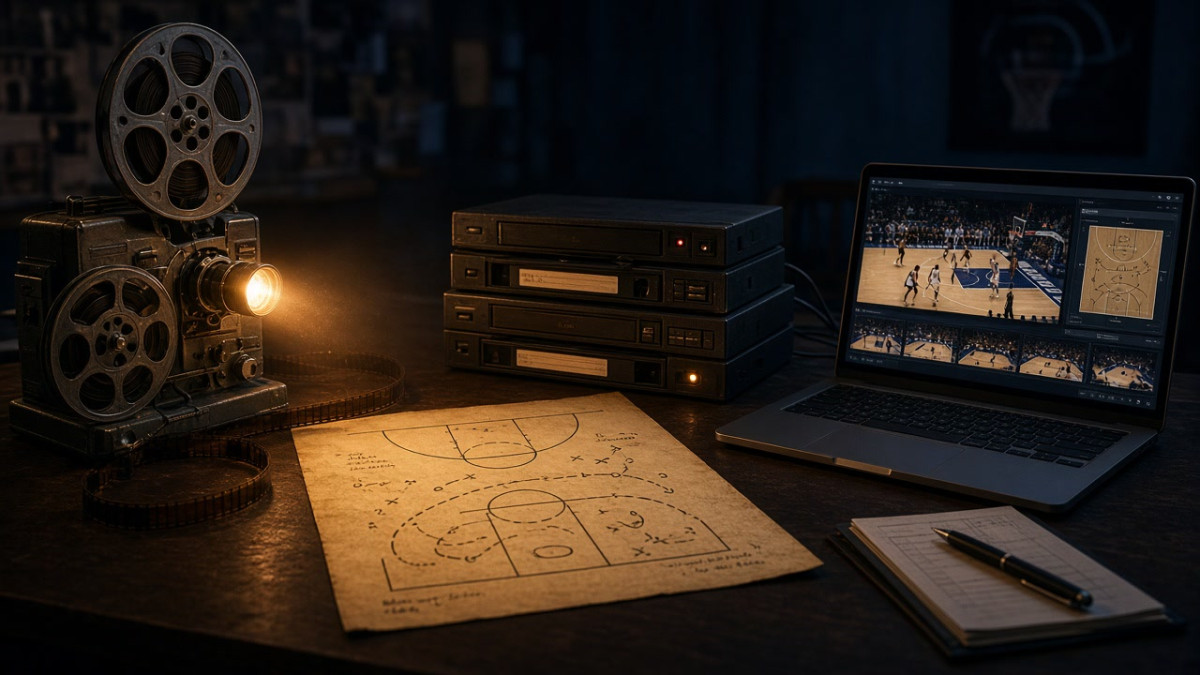
Before Basketball Video Software: How Coaches Studied the Game
Long before searchable clips and automated statistics, coaches relied on notebooks, shot charts, 16mm reels, mailed VHS tapes and hours of manual editing.
Before coaches could filter every pick-and-roll from five games, somebody had to watch five games.
Before a clip could be shared to a player's phone, a reel had to be threaded through a projector or a tape copied from one machine to another. Before video and statistics lived in the same platform, staff members connected them with handwritten notes.
Basketball analysis did not begin with software. Software organized a long-established habit: observe, record, compare and teach.
The earliest surviving film was not yet coaching film
The Library of Congress preserves a 58-second silent film titled Basket Ball, Missouri Valley College, recorded on April 26, 1904. It shows a women's game and is one of the earliest surviving pieces of basketball footage in a major public archive.
It should not be called the first basketball film with certainty. Earlier footage may have been lost or may remain unidentified. It is better understood as an early surviving record of what the game looked like.
At that stage, film was a novelty. Coaches still gathered most of their useful information by watching in person and writing things down.
Coaches built data with pencils and court diagrams
Early scouting depended on observation, relationships and memory. Coaches attended games, spoke with other coaches, read newspaper accounts and kept notes on lineups, habits and plays.
They also charted events.
A 1937 study of Indiana high-school basketball found that roughly seven out of eight responding coaches used some form of shot chart. Staff marked attempts on a court diagram, circled makes and calculated percentages by hand. By 1952, the University of Oregon used five chart-keepers to record shots, rebounds, ball control and assists.
That system could produce valuable coaching information, but every additional question required more human attention. If a coach wanted shot location, rebounding and ball-control data, several people might track different parts of the same game.
The spreadsheet had not arrived. The staff was the database.
Television made basketball visible, not automatically reusable
The NCAA identifies Pittsburgh versus Fordham at Madison Square Garden on February 28, 1940 as the first televised college basketball game.
That was an important broadcast milestone, but television did not instantly give coaches a permanent recording. Live pictures and reusable coaching film were different products. A staff needed access to a recording, a projector or tape machine, and enough time to study it.
For decades, the most useful coaching angle was often created by the team or athletic department rather than the network.
16mm film gave coaches a second look
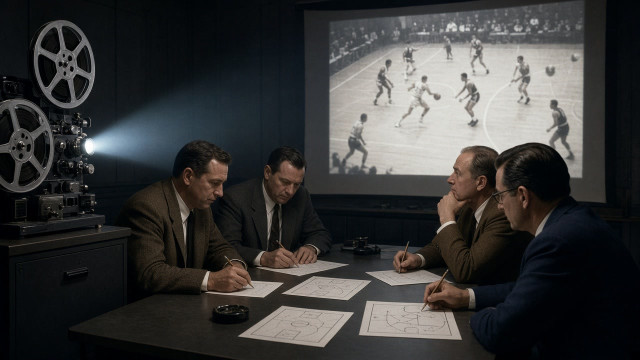
University archives document silent 16mm basketball film made for coaching staffs by the late 1940s and 1950s. Duke's men's basketball film collection begins in 1947. Notre Dame archives preserve reels explicitly labeled "Coaches Film" from 1960.
A typical workflow was physical:
- Film the game from a fixed elevated position.
- Develop the reel.
- Set up a projector and screen.
- Rewatch possessions while taking notes.
- Stop, rewind or physically edit film for teaching sequences.
- Exchange reels with another program when scouting an opponent.
The process was slow and access was uneven. Some programs had regular film; others relied more heavily on live scouting reports and information from trusted coaching contacts.
Still, film changed the conversation. A coach no longer had to rely only on memory. The staff could return to the same possession and show players exactly what happened.
Film exchange ran on relationships
There was no universal cloud library. Teams requested opponent reels from schools, friendly coaches, television stations or commercial scouting services.
That made preparation partly a network problem. A staff needed to know who had filmed the opponent, whether that person would share the footage and how quickly the reel could arrive.
When film was unavailable, the fallback remained familiar: attend the game, write a report, sketch the sets and call someone who had seen the team play.
Information moved at the speed of trust, travel and delivery.
VHS made film easier and the workload larger
Videotape gradually replaced much of the 16mm workflow during the 1970s and 1980s. VHS was easier to record, duplicate, mail and replay. Coaches could also capture television broadcasts.
By 1987, the Los Angeles Times described NCAA tournament staffs making calls around the country to locate opponent tapes and said videotape had become as common as the locker-room chalkboard.
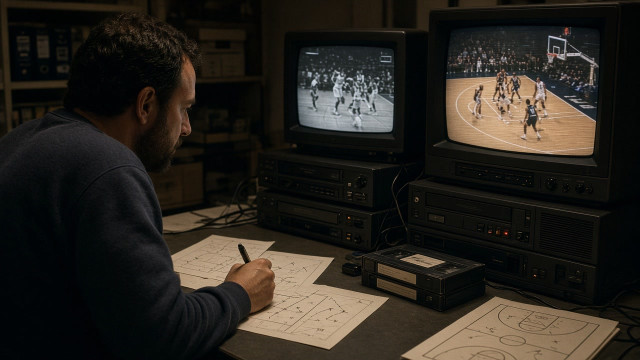
The tape was easier to handle than film, but editing remained linear. To build a teaching reel, a staff member had to:
- Find a possession on the source tape.
- Set an in point by hand.
- Record it onto a second tape deck.
- Stop the copy.
- Search for the next possession.
- Repeat until the edit was complete.
A ten-minute scouting cut might require hours of shuttling forward and backward.
The video coordinator became a basketball job
As teams collected more footage, somebody had to manage it.
Dedicated video roles grew during the late 1980s and 1990s. Video coordinators recorded games and practices, logged possessions, prepared opponent edits and produced written reports for coaches. The job required technical patience and basketball judgment.
Dan Burke began full-time video work with Portland in 1988 and later described an era of VCRs and paper reports. Similar roles expanded across professional and college staffs.
The video room also became a coaching classroom. Repeatedly watching the same actions taught coordinators how teams created advantages, disguised coverages and punished mistakes. Many future coaches built their careers from that room.
Nonlinear editing removed the need to search in order
The next breakthrough was not a new camera. It was random access.
With linear tape, a possession near the end could only be reached by moving through the tape. Nonlinear digital editing let staff jump directly to stored clips and rearrange them without copying everything in sequence.
Phoenix video analyst Garrick Barr has described adopting an Avid digital editor in 1992, an important early NBA example. Staff could organize clips rapidly, reorder a presentation and output the finished sequence back to tape.
The work still required someone to identify and label every possession. But once the clips were logged, the coach could retrieve them much faster.
Video and statistics finally became one searchable system
By the late 1990s and 2000s, basketball platforms began connecting possession tags directly to video.
Instead of reading that an opponent used a certain action frequently, a coach could click the category and watch every matching possession. Filters could combine play type, player, result, location and game situation.
That changed preparation in three ways:
- Search became immediate. Staff no longer had to remember where a play lived on a tape.
- Evidence traveled with the claim. A tendency in a report could open the supporting clips.
- Teaching packages became reusable. Coaches could save, annotate and share playlists without creating a new physical tape.
Optical tracking later added player and ball coordinates. Automated capture simplified recording. Cloud exchange removed much of the mailing and calling. But the basic coaching loop remained the same: find the pattern, verify it on film, decide what to teach.
What coaches had before software
The pre-software toolkit was more capable than it may look from today's perspective:
- Live observation supplied tactical context.
- Box scores preserved official outcomes.
- Shot charts revealed location patterns.
- Written scouting reports organized personnel and sets.
- Film and tape made possessions repeatable.
- Video coordinators connected those sources through manual logging.
The limitation was not a lack of basketball knowledge. It was the cost of retrieval. A question that takes seconds to search today might once have required several people, several calls and several hours of rewinding.
Software did not replace coaching judgment
Modern analysis platforms can capture, store, tag, search and share far more information than a film room could manage on paper. They can return clips beside statistics and preserve an entire season in one record.
What they cannot do alone is decide what matters for a particular team.
A coach still has to separate a repeated problem from one unusual possession, decide which detail a player is ready to absorb and turn information into a plan. The software should reduce the mechanical work so the staff has more time for those decisions.
Playtics continues that progression. Teams use the film they already record, then receive box scores for both sides, minutes, plus-minus, shot locations and organized highlights. The goal is not to remove the film room. It is to give the people in it a faster starting point.
If your staff is still spending the night counting and cutting, tell us about your current workflow.
Sources and further reading
- Basket Ball, Missouri Valley College, Library of Congress
- An Experimental Study of Shot Charts as an Aid in Coaching Basketball, Robert L. Wright, 1937
- The First College Basketball Game on TV Was Pitt vs. Fordham in 1940, NCAA
- Guide to the Men's Basketball Game Film Collection, 1947-1996, Duke University Archives
- Notre Dame vs. Canisius: Coaches Film, University of Notre Dame Archives
- College Basketball Coaches Use Videotapes to Scout the Opposition, Los Angeles Times
- Synergy Sports Tech Has Changed the Game of Basketball Analysis, Cronkite News
- NBA Expands Partnership with STATS LLC, NBA Communications