
One Basketball Program, Many Teams: How to Build a Useful Season Record
Multi-team clubs do not need more disconnected spreadsheets. They need every game, player, and team organized consistently—without taking control away from coaches.
A basketball club with one team can survive a messy spreadsheet. A program with ten or twenty-five teams cannot.
Every additional roster creates another schedule, another folder of game film, another set of player names, and another person deciding how statistics should be recorded. By midseason, the club may have plenty of information but no consistent record.
The problem is not a lack of effort. It is fragmentation.
A useful multi-team system should give each coach a clean place to work while giving the program a consistent structure across teams during the season.
What breaks when every team builds its own system
Independent teams naturally develop independent habits. One coach tracks minutes; another does not. One records shot locations; another keeps only points and rebounds. Files live in personal drives, group chats, laptops, and camera accounts.
That creates predictable problems:
- Player names are entered differently from game to game.
- Statistical definitions change between teams.
- Film and numbers live in separate places.
- Season totals require manual consolidation.
- When a coach leaves, part of the record may leave too.
- Program directors cannot tell what is complete without asking every team.
None of these failures happens during the game. They appear later, when someone needs a season summary, a player history, or a clean handoff between squads.
Begin with one standard for every game
Consistency starts with the game-level output.
Every uploaded recording should return the same core record:
- A player-by-player box score for both teams
- Minutes and plus-minus for your players
- Shot locations by zone
- Highlights per player, per team, and per game
When every team begins with the same structure, season totals stop depending on who happened to keep the spreadsheet that week.
This does not require every coach to teach the same way. It only ensures that the underlying record is comparable and complete.
Keep teams separate without making the program fragmented
“One program” should not mean one crowded dashboard where everyone sees everything.
Each team needs its own roster, games, and working space. Coaches and analysts should control their team’s corrections and decide what they share. A program can maintain consistent organization without routing reports over the people who produce and use them.
That balance matters:
- Team-level ownership keeps the workflow useful for coaches.
- Program-level organization keeps accounts, rosters, and games from becoming disconnected.
- Clear permissions prevent convenience from becoming unwanted surveillance.
The system should follow the real organization instead of forcing the organization to follow the software.
Turn separate games into a season history
A box score is most useful when it becomes part of a sequence.
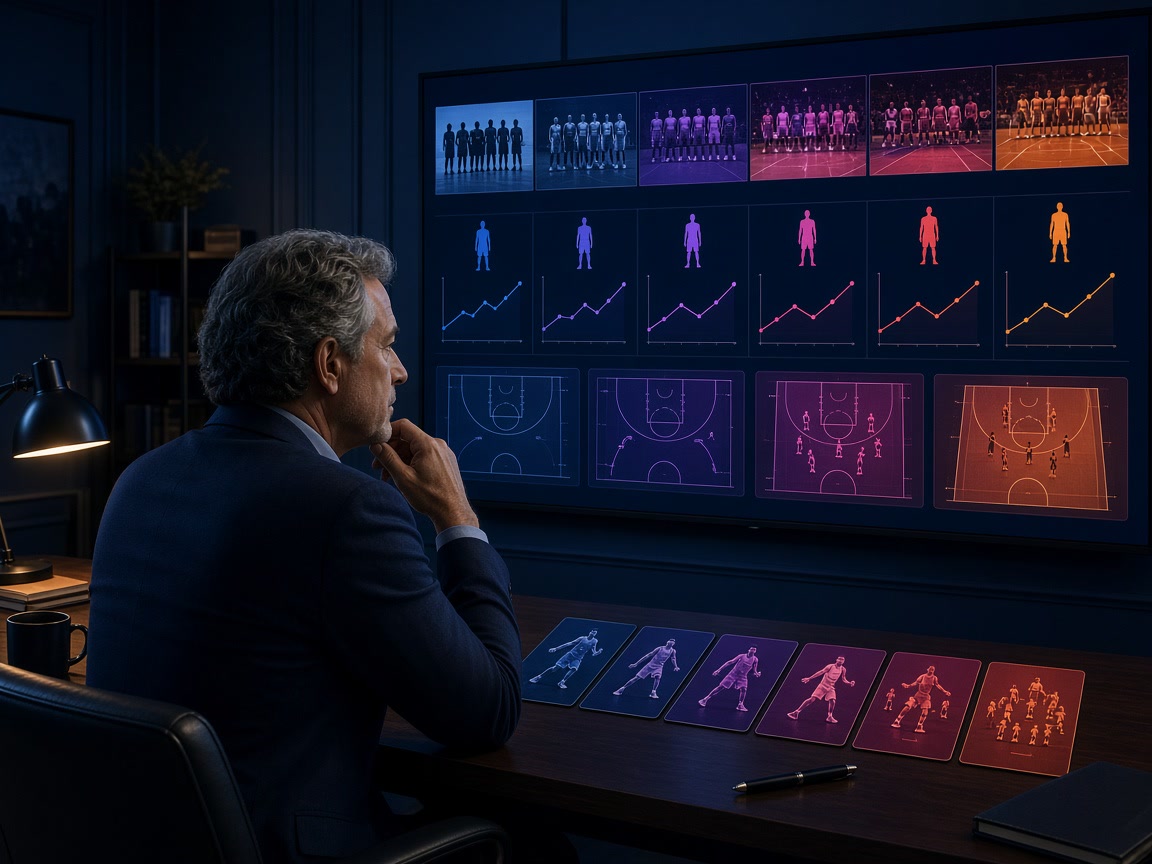
For each player, the current-season record should grow after every upload. Coaches can then review how minutes, shooting, turnovers, rebounds, and other contributions change over time.
That helps replace vague impressions with better questions:
- Has the player’s role changed, or only their scoring?
- Are turnovers falling as minutes increase?
- Is the shot profile becoming more consistent?
- Was a strong game an exception or part of a trend?
- Which clips best show the player’s progress?
The history does not grade the player by itself. It gives the coach evidence to pair with observation.
Make movement between squads easier to manage
During a season, players may move between squads within the same program. Without a shared structure, that transition can reset the context. The receiving coach gets a name and perhaps a few clips, but not always an organized record of the player’s recent games.
A consistent program structure makes the handoff more useful. The coaches can share the relevant current-season numbers and highlights while the receiving coach still forms an independent judgment.
The principle is continuity, not comparison. Player development should not become a public ranking table. Each athlete’s record is most valuable as a conversation about that athlete’s own role and progress.
Give every role the view it actually needs
A club includes several different users:
Coaches
Need their roster, games, corrections, season numbers, and clips without extra administrative work.
Program directors
Need teams organized under one program and confidence that the season record is not scattered across private files.
Analysts or video staff
Need ownership of the breakdown, the ability to make corrections, and control over what is sent onward.
Players
Need access to the information and highlights intended for them, without default comparisons to teammates.
Good software respects those differences. More visibility is not automatically better; appropriate visibility is.
Reduce administration without flattening the basketball
Standardization can go too far. A twenty-five-team club may want one statistical structure, but each coach will still have different priorities, terminology, and teaching methods.
The shared system should automate the repeatable layer:
- Receiving the game
- Producing the core statistics
- Organizing the highlights
- Adding results to the current season
- Keeping the program’s teams under one account
The basketball layer stays with the staff: what to emphasize, which clips to show, and how to develop each player.
A practical structure for a multi-team program
Before adopting any system, define:
- Who owns each team’s data? Usually the coach or analyst responsible for the work.
- Who can correct a game? Keep that authority close to the team.
- What rolls up to the program? Organization and agreed reporting—not unrestricted access by default.
- How are players identified during the season? Avoid duplicate or broken records.
- What remains when staff changes? The program should retain an orderly record with appropriate permissions.
These rules matter as much as the feature list. A clean database with unclear ownership will eventually create resistance.
One account should make the club feel smaller
Managing more teams will always create more games. It should not create proportionally more tagging, spreadsheets, and folders.
With Playtics, programs can keep several teams under one roof. Each uploaded game adds both teams’ box scores, shot zones, minutes, plus-minus, and highlights to an organized current-season record within a few hours. Coaches keep the judgment and correction path; the program keeps continuity.
The result is not centralized coaching. It is centralized order—so every staff can spend more of the week on its own team.
Managing several teams under one program? Tell us how your club works today.